Monday, 1 September 2014

Clayton Kershaw: Rolling To Award Season

By Special Guest Contributor Sam Wallace

Could Kershaw Win Another Cy Young AND MVP?

When Clayton Kershaw started the year with some nagging injuries, there were some who were worried about how his 2014 season would play out. People in fantasy baseball decided to wait a little while longer to draft him, and all of a sudden the playoff hopes of the Los Angeles Dodgers were a little bit up in the air. However, since returning to the rotation, he has been as dominant as ever. He has been so dominant, there is actually a decent chance of him winning both the Cy Young Award and MVP in the National League in 2014.

Truth be told, it has not been a particularly great year for individuals in the National League so far. There seems to be 3 other legitimate candidates out there to compete with Kershaw, and they all have their flaws. Giancarlo Stanton is as good of a hitter as you can find, but he is playing for a team that is not in contention for the playoffs. Andrew McCutchen has missed playing time recently due to injury, and Jonathan Lucroy at the end of the day is a catcher with somewhat limited offensive production. That leaves Kershaw, the best pitcher by far on the best team in the National League at this point in time.

Consistency has always been huge for Kershaw, and 2014 is certainly not an exception. In fact, he is somehow lowering his ERA after having a 1.83 in 2013. He is also at 16 wins already this year, and there is a legitimate chance he gets to 20 wins for the 2nd time in his career. However, most rewarding fact for him is that he is going to have a chance to win his 1st ever World Series title thanks to being on a solid team.

When it comes to being the most valuable player in the National League, there are going to be plenty of voters who are hesitant to give it to someone who only plays in 20% of their team’s games. Justin Verlander pulled it off in the American League in 2011, but it has not been done in the National League since Bob Gibson in 1968. With a strong September, Kershaw could once again stand out amongst his peers.

Monday, 20 January 2014

Exit Sandman

The calendar has turned over to 2014, and the New York Yankees are trying to piece together a contender for this upcoming season. Things still feel a little different around the squad, as Marino Rivera has officially retired and can therefore no longer be counted on to close games. Fantasy baseball owners will definitely miss his production, but what baseball will miss more is one of the best individuals in the history of the game.
 Baseball certainly has suffered from its fair share of controversy in the past, but that never seemed to be anywhere near Rivera. It is rare that such a dominant pitcher is also so universally liked by not only his teammates, but also his opponents. In movies, closers are often depicted as the villains who are a little crazy. In fact, there are quite a few closers who are not exactly all there. However, during Rivera’s farewell tour, fans around the United States got to see one of the most graceful yet overpowering pitchers take the mound in the 9th inning and close out a victory.

After converting from an infielder to a pitcher, Rivera basically got away with throwing one pitch his entire career. It just so happens that that one pitch might be the most unhittable pitch of all time. His cutter was dominant against right-handed and left-handed hitters during his entire career. Even when his velocity started to go down a little bit, he was still able to place the ball where he needed to in order to have success. In an age where most closers have multiple pitches and even throw harder than him, Rivera kept it pretty simple while being very dominant.

Fittingly, Rivera will be the last player in baseball history to where the number 42. It has been officially retired throughout baseball because of Jackie Robinson, but the Yankees will probably do something to make sure that they honor Rivera as well. New York will be forced to find a new closer this season, and fantasy baseball owners will have to finally targets somebody else. The New York Yankees might be trying to move on, but replacing Rivera will be easier said than done in 2014 and beyond.

Sunday, 26 May 2013

5-4, 1 Out, Bottom of the 9th

Baseball is a sport that is filled with the ebb and flow of potential. In each inning, the number of baserunners is balanced against the number of outs, and as the bases fill up, the potential for runs builds. If a strikeout is recorded, or a double play turned, the run potential is turned down a few notches. The informed fan starts thinking about each runner: How fast are they? Could they score from second on a single? From first on a double? We wonder which outfielder has the best arm to make a play at home plate. All of this up and down, possibilities being turned over and around with each pitch, yet nothing has really happened. Often a pitcher in a bases loaded situation calls upon skill and luck and a rally is washed away with no damage done on the scoreboard.

When I watch hockey or soccer, that's what I miss. I can't seem to get excited about the time spent pushing back and forth in the neutral territory between goals, scrambling to get control of the puck or the ball. Then, snap, with no change in strategy, one second later, there's a point on the board. Then the game resets to neutral. I just can't see where things came together for the scoring team, or fell apart for the one that was scored upon. In baseball, there's time for my heart to start pounding.

The real pressure situations in baseball, where the tension is ratcheted up with every pitch, occur in the bottom of the 9th in a close game, and then in the bottom of every tied inning in an extra inning game. Often, each batter comes up with the potential to lengthen the game (by tying it with a home run), or to win it (with runners scoring ahead of him). The best part of these situations is that they always occur at home, so there are no quiet rallies in the bottom of the 9th or later - the crowd is always on the edge of their seat. Victory will be assured right away, falling behind only means a tougher turn at the plate when they try to mount a comeback. When successful, there is a sense of elation, of turning a difficult, against the odds situation, into a victory. The home team is free to walk off the field and back into the clubhouse.

Baseball has a term for these things. They are 'walkoff wins'. Before I continue talking about the thrill of a walkoff, I will note the lone exception. With the bases loaded, and the score tied, there is always a possibility that the pitcher will be unable to find the strike zone. This level of pitching ineptness results in a walk that forces in the winning run. All the runners trot to the next base, and the game is over. There is no play to be made, and mobbing and backslapping the batter who took the walk seems... odd. This is the dreaded Walkoff Walk. A quick overview of the oddly aniclimactic play (and the internet's weird ritual surrounding it), is certainly worth a read. There was a walkoff walk in Tampa Bay earlier this month.

That's the exception, most every other  time it happens, the walkoff is a jubilant moment. There are, of course, degrees of jubilation. The walkoff single with nobody out and the bases loaded? That's just hastening the inevitable. Everybody is happy, but bases loaded and nobody out, there's an expectation of scoring a run, and when one run will win the ball game... well, lets just reflect on the disappointment that you might feel if your team came out of that situation without scoring. Yeah, I'd be a bit frustrated too.

From that point of view, I can assume that the better walkoff, in terms of excitement, is the come from behind sort. Down a run or two, runners on base. In those situations, the announcers love to remind us, the clueless fan, where the winning run is. 'The Rockies bring the winning run to the plate,' they say. or 'The winning run is on second for the Yankees.' I'm pretty good at counting bases and such, myself, but if it make them feel better, let them spell it out.

In the 1993 World series, the winning run was on first base when Joe Carter came to the plate. History remembers this walkoff with more intensity than any other. I can't blame history here. It is an immensely satisfying result. Why? In childhood dreams, we often find ourselves imaging the last at bat of the World Series with our selves at the plate. Carter got to live out the fantasy. Taking a 2 out, 2 strike pitch over the outfield wall. He did three things with one swing of the bat every kid dreams of doing. He brought his team from behind to ahead, he won the game, and he ended the World Series. Carter's walkoff had the biggest impact of any in baseball history.

To be exicting, a walkoff hit doesn't need to happen in the World Series. Often, the more unlikely the hero, the more jubilant the celebration. On May 26th, 2013, the Toronto Blue Jays started the bottom of the 9th down by 3 runs. The Orioles closer, Jim Johnson, was trying to protect a large lead and save the game, which would have been the third win in a row for his team.

Interestingly enough, the Blue Jays had loaded the bases in both the 7th and 8th innings, and had only scratched out one run. The 9th inning went like this: Double, Single, Single (Run Scored), Flyout, Walk, Fielder's choice( 1 runner out, run scores) . That's 2 outs, and 2 runs in. Runners still on first and third. The Jays are down to their last out.

The next man up is Munenori Kawasaki. I've written about Kawasaki before at this site, and may well write about him again. He is a character, and a wonderful person by all accounts, but he is merely a replacement for the injured Jose Reyes. The word 'antics' comes up following his name often, certainly much more often than the word 'heroics'. Jim Johnson surely knew he was facing a slap hitting, backup infielder. Mune's batting average was .217. Most Jays fans were probably hoping he could work a walk. Instead, on Jim Johnson's 37 pitch of the inning, he did this:


That is a walkoff which is only multiplied by the enthusiasm of the player who got the hit. From behind to victorious on one swing, it put a charge into the Rogers Centre crowd.

To add one last note to Kawa-walk-off-a-saki's story, you should probably go watch his unforgettable post game interview.

And you thought I was done.

Nope, because, even though you get a lot of credit for magic with 20 year old World Series moments, and come from behind doubles, that's not the topper of all walkoffs.
The ultimate walkoff is, in my humble opinion, the come-from-behind-inside-the-park-walkoff-home-run. That's a lot of hyphens, I know, but that's how it sounds in my head.

In the only ballpark that this makes any sense in whatsoever, AT&T Park in San Fransisco. Angel Pagan has a man on second, and his team is down by one.... it's the last of the 9th. And there's a deep, deep alley in right centre field.


Or, if you'd prefer the radio call, click here. Never underestimate the decision of Tim Flannery, the third base coach, who would have been second guessed for a week if Pagan had been thrown out.

Now that's baseball. And it is Magic. It is the wonder of childhood, it is the thrill of victory, it is the sense of awe at snatching victory from the jaws of defeat.

If you have any doubts, take a look at the faces of these men in the pictures below, no these boys in the pictures below, and tell me they don't feel the magic.

Kawasaki pic from @james_in_to
Jumpin' Joe Carter
Exuberant Angel


Sunday, 21 April 2013

Testing the Old Adage

You can't steal first base.

That's an old baseball truism. That saying is usually pulled out of the cliche drawer, and plugged into the conversation when a speedy young rookie comes up, swinging at everything. We hear about how fast he is, but when a player is batting under .200, he never gets a chance to show off his wheels? Why- because you can't steal first base. Once you're on first, stealing second is easiest, it's the longest throw for the catcher. Stealing third is all in the timing of the jump. Stealing home is as difficult as it is rare. Speed in baseball is a conditional threat. Unless you reach, you cannot run.

So, that's it: You can't steal first base.*

Yeah, I put that asterisk there. What fun would life be without exceptions to the rule? Even with an old axiom so obviously cut and dried, there's a way to steal first base. Not to any particular advantage, mind you, but it can still be done.

Jean Segura started this play on second, broke for third, and found himself picked off, and in a rundown. Then, he found himself standing face to face with Ryan Braun, who had also taken the opportunity to reach second base.

Then the fielder with the ball did what you should always do in this situation. Tag everybody you can, and let the umpire figure it out.
Hat tip to @gidget on Twitter
The umpire rules that Braun is out, as per the following rule:
7.03
(a) Two runners may not occupy a base, but if, while the ball is alive, two runners are touching a base, the following runner shall be out when tagged and the preceding runner is entitled to the base, unless Rule 7.03(b) applies.
(b) If a runner is forced to advance by reason of the batter becoming a runner and two runners are touching a base to which the following runner is forced, the following runner is entitled to the base and the preceding runner shall be out when tagged or when a fielder possesses the ball and touches the base to which such preceding runner is forced.
Since Braun is not being forced to second on the pickoff, he's out by virtue of being the tailing runner. Now the funny thing is, the ball is live the whole time. If Segura is tagged while off the base, he is also out. I'm pretty sure the second glove slap from the infielder happens after he takes a step towards first, but it's a tough call. The umpire is trying to think about rule 7.03 (a), and he might not have been watching real closely for the tag there. I'm not sure I would want a replay here, because it would suck all the fun out of Segura heading back towards his dugout, then being told he should stop at first - because he's still a baserunner.

The story has more to it, of course. Courtesy of this recap from Rob Neyer. Go read it, there's another backwards base stealing tale from 1911 in there. 

The topper to the Jean Segura mix up is that he tried to steal his way back to second in the same inning, but was thrown out. Hope you were scoring at home!

What Mr. Neyer did not include in his recap was the immortal baserunning of Lloyd 'Shaker' Moseby. Captured here via YouTube clip. Shout out to @minor_leaguer and @truebluela for remembering this one.


I understand why Moseby is safe at both ends of this play. What I don't understand is why he goes back to first. The only thing I can conceive, is that he thinks the play is a fly ball, not a throw to second. Boggles the mind. In a good way, because just when you think you've seen it all.... baseball has another trick up it's sleeve.

Sunday, 14 April 2013

4-6-5-6-5-3-4 Triple Play

The Baltimore Orioles, 2012 edition, were the Team Of Destiny. They had a late inning mojo that carried them into the postseason. What do I mean when I say mojo? Well, Jayson Stark breaks down all the extra inning accomplishments in a post from last September (Bullet point 2). Adding to the extra innings accomplishments, when leading after 7 innings, they were 74-0. You could bank on the Orioles last year, when the chips were down, they came through. Those records have a lot to do with factors that are really not in the player's control. You can't really be so good you have invincible pitchers for the last 2 innings of every game, if they really existed, they wouldn't give up runs in any other innings either. Some of that run to the playoffs was built on luck.

If luck plays a part in creating favourable circumstances, it can certainly play a part in creating unfavourable ones too.

Sunday, 7 April 2013

Double to CF

If you've read anything else I've written here, a couple of things should be obvious. 1) I enjoy watching a lot of baseball. 2) I value anything unexpected, anything that breaks up the rhythm of the game. It reminds me that sport, like life, can be a learning experience. The rules in baseball don't change much, but with fields, players, and field conditions changing all the time, the action on the field is always in a state of flux.
Emilio Bonifacio is new. Well, he's new to my eyes, and that's more than enough in this case. He's been playing second base in Toronto for less than a week, mostly because Brett Lawrie is injured. From the World Baseball Classic, I learned that he's a high energy player. His above average baseball tool: speed.
When he grounded a ball up the middle, he had every intention of making it to second base. Here are 2 GIF's of the play, courtesy of Matt at House of the Bluebird, showing him sprinting out of the box and then getting into second base without even being tagged.

So, on a scale of fast to FAST, Bonifacio appears to register as FAST in this real-life example.

As usual with baseball, there's another game tomorrow, and that game adds a little wrinkle to the story. The game I'm referring to doesn't even feature Emilio Bonifacio. Cleveland left Toronto, and continue their road trip in Tampa Bay. Baseball reference has play by play for every play of every game, and this one line came to my attention.
That's Yunel Escobar, who is probably only Fast on my scale of fastness. So what are the odds of another ground ball to centre field resulting in a double? I don't have a video highlight to help me out. I do, however, have twitter.

So Bourn was challenged again, and this time, he made the play. Only he didn't get credit for making the play. Why would Escobar even try to hustle a double? Hmmm, curious. Escobar, Bonifacio, and Bourn have all faced one another in the NL East in the past. When transplanting players to the AL East, did a little bit of knowledge come with them about Mr. Bourn?
I suppose only time will tell but maybe, this play it isn't about what we thought it was about.
This is not relevant, but I found it on Google. Only photo I am ever using of Micheal Bourn. Ever.

Saturday, 6 April 2013

Joining the Club

Yu Darvish stands over the rubber, tired, sweating. It is the bottom of the ninth inning, at Minute Maid Park in Houston. The bases are empty. Marwin Gonzalez is at the plate. A.J. Pierzynski is squatting behind the plate, dropping down fingers as Yu looks for a pitch he wants. He is pitching this game in enemy territory, and his Rangers have scored seven runs. The crowd, resigned to a home team loss, is, strangely, on its feet in anticipation.

Darvish is trying to join a baseball fraternity. He is very, very close to being perfect. One more batter retired, and Yu Darvish will have thrown a Perfect Game.
Briefly, if you are unfamiliar with Perfect Games, they occur when a pitcher retires every batter before they can reach first base. If he does it twenty seven times, he has recorded a full games worth of outs. As long as his team has scored, the game is over, and for one night, the pitcher is perfect. Any pitcher can be perfect for one night, it has been done 23 times before.

Sunday, 17 March 2013

Just One Silly Question

This all started with a question about the player pictured on the right. A player who I could not identify if I were to run into him on the street. He is Tim Collins. He plays baseball for the Kansas City Royals.
I became aware of the existence of Tim Collins a couple of years ago, when he was a minor leaguer in the Toronto Blue Jays system. I learned only two things about Tim while he was property of the Blue Jays. 1: He's short. 2: He throws baseballs very hard.
Since he left the Blue Jays system via a trade to the Braves, then a trade to the Royals, I've retained those two facts in my head. And nothing else about him.
The other night, in the World Baseball Classic, Tim Collins made a relief appearance for team U.S.A., just after Dan Brooks (who I follow @brooksbaseball on Twitter) had confirmed a winner in a pitch f/x trivia quiz.
Now, I will digress here to explain what Pitch f/x is, and what it has to do with a trivia quiz. Dan and Harry Pavlidis run BrooksBaseball.net, which is a free, online database of information gathered by Major League Baseball's Pitch f/x system. The database contains information on the characteristics of every pitch thrown in MLB since 2008. Pitch speed/spin and movement is tracked by a specialised camera system set up in each ballpark. Dan will, when he's in the mood, dig into the database, and ask questions from the gathered data. An example might be: Which pitcher has the largest difference between his fastball and changeup? Or what pitcher is most willing to throw a curveball in a 3-2 count? Odd facts, but things that make me think about the game on a different level. I enjoy these little side trips away from the action in a dull game, and I like to see other follower's guesses.
So, during 'Tiny' Tim Collins appearance, I put the only two things I knew about Tim Collins together and asked the following question.

So Dan liked the question, and he put it out to his followers.

Which I thought was excellent. Tim Collins, though only 5'7", only managed to get second on the list. It took very little time to find the correct answer.

 Which led to the following response from the person with the correct answer.

At this point, I assume that @rsaggiadi was so quick to guess because he was assuming the Mr. Brooks had posted the question, only after having seen the two players already appear in the game. In fact, Dan only noticed after it was pointed out to him.


So, that is the end of the trivia quiz. Kelvin Hererra is 5'9", and throw 97.4 mph on average. But Dan is still looking at his list of pitchers who bring the heat from their below average height, and there's a funny thing about the list.


And so it came to pass that Craig Kimbrel, pitcher number four in velocity/height entered the game. He gave up two runs, setting up a save situation for the Dominican team. Off of the bullpen mound steps Fernando Rodney. Rodney is 5'11" and throws 96.2 mph. He is the third faster pitcher by height in the majors right now.

Now, is this significant? No. It was sure fun for me though! I picked a question to ask based on the following "There's that short guy who throws hard. I wonder if that's really that different." I was rewarded with an incredibly odd coincidence, as the top four pitchers, from a pool of almost 500 who appeared in the big leagues in 2012, also appeared in the game, like a Bleacher Report slideshow.
It also makes me speculate: Do the guys who have less physical tools, or have been told they are below average, have a bigger reason to say yes to the WBC when it comes calling? Are some of them willing to go, just to prove that they are worth being representatives of their country?

The final topper for all of this came a little bit later, when I got this tweet from Dan Brooks.

 I was, once again, very pleased that one silly question had such a good run.

 Now, to all of you who say that statistics make the game less fun, I must disagree. Without the numbers to tell the tale, I never get to enjoy the magic of discovering any of this weirdness. We don't have to learn anything earth shattering to find that we love the game in a different way, we just have to ask the right questions at the right time, no matter how silly they are.

Friday, 8 February 2013

Guest Post: King of Perfection

One of the stories I never quite got around to writing about in 2012 was the perfect game thrown by Felix Hernandez of the Mariners. Today's guest poster has been nice enough to correct that oversight:


Even With Perfection, Felix Hernandez Was Overlooked

     Despite another lost season for the Seattle Mariners, in August of 2012 the team experienced their ace reach true perfection. Felix Hernandez threw the 23rd perfect game in baseball history last year, and the 2nd of 2012 when he faced the Tampa Bay Rays.
     From the very beginning, Hernandez was looking even better than the Cy Young Award winner has in the past. He began the game by inducing a ton of weakly hit ground balls and fly outs. Striking out two the first time through the order was impressive, but it was not until the sixth inning that things got interesting.
     In the top of the sixth, Hernandez began to turn it up a notch, and the crowd took notice. He struck out the 7-8-9 hitters for the Rays to complete the second time through the order. When he came out for the seventh, he got outfielder Sam Fuld to roll over a ball, but then BJ Upton came up for the most controversial part of the perfect game.
      Upton grounded out to Sean Rodriguez at third base, but Rays manager Joel Madden would come out and actually be ejected for arguing the call. After a delay, some wondered if Hernandez would cool down. He responded by striking out five of the last six batters he faced, putting his stamp on baseball history.
     With so many perfect games and no hitters thrown in recent memory, Hernandez never really received the attention he deserved, even in fantasy baseball circles. In fact, that has sort of been his problem his entire career. Even during his Cy Young award season, many looked at his 13-12 record as though it was his fault.
      Ironically, the Mariners only offered him one run of support during that August game. He was one swing away from getting a no-decision in that game for the ages. Even by Hernandez’s standards, he was simply dominant in every way manageable in that game.


Saturday, 29 December 2012

Guest Post: Blockbuster


A look back at magical moments from:
Special guest author Minor Leaguer from Bluebird Banter


“MAR-CO SCU-TA-RO! *clap clap clap clap clap*” There’s something magical about such a chantable name, isn’t there? 

San Francisco Giants fans had little reason to chant Marco Scutaro’s name when he was acquired from the Colorado Rockies for AAA prospect Charlie Culberson. They were in first place and just acquired a 36-year old infielder who was batting .271/.324/.361 in the thin air of Denver. The Giants needed someone to fill at the hot corner after Kung Fu Panda tried to do splits, and when Pablo Sandoval was to return, the team needed someone to replace either Brandon Crawford or Ryan Theriot afterwards—two players who barely scraped above .300 OBP. They could’ve done better—they could’ve tried to acquire someone with a bigger name to catch up with the haul that the Los Angeles Dodgers got from the Boston Red Sox.

But it turned out to be the best deadline trade of 2012. His teammates grew to love Marco so much they actually started calling him “Blockbuster,” and after the Giants won the NLCS, ace Matt Cain called the trade “the best thing that’s ever happened so far.” Better than his wedding day, better than the day his daughter was born. What did Marco do to deserve all the praise? 

In the two remaining months of the regular season after Marco first put on a Giants uniform he hit .362/.385/.473—he went from creating 25% fewer runs than the league in Colorado (75 wRC+) to being 37% above average in San Francisco (137 wRC+). His strikeout rate dropped from an 8.4% before the trade to 5.2% afterwards. (For comparison, the 2012 Toronto Blue Jays’ second baseman Kelly Johnson had a 27.4% strikeout rate.) 

He was on a red-hot streak entering the playoffs, but then the magic started: he somehow just stopped missing baseballs. He played all five games of the NLDS and did not strikeout once, and only recorded one K in the seven NLCS games. Fangraphs’ Jeff Sullivan looked through every single Marco Scutaro at bat during the NLCS. and found that, out of the 78 swings he took, he only missed the ball twice. In that magical seven-game series against the St. Louis Cardinals, he hit .500/.533/.607, he didn’t go 0-for in any game and managed to record six multi-hit games, collecting 14 hits in 28 at bats. 

But the magic could have easily ended in the top of the first in game 2 of the NLCS. Marco, the 5’10”/185-pound second baseman, was trying to turn a double play when he was crushed by Cardinals’ 6’4”/235-pound runner Matt Holliday’s hard slide over second base. AT&T Park was showering boos as Marco rolled around the infield dirt in pain. Watching on TV, I thought his season was over.
  
But as you can see in the video, after a few minutes, the diminutive Venezuelan stood right up, dusted himself off and continued playing for his team. Two batters later and it was his turn to come up to bat and what did he do? Slam a line drive single up the middle against Chris Carpenter. Later in the game, he loosened a tight 2-1 Giants lead by lining another single with the bases loaded, scoring three (with the help of an error). He continued his success against Carpenter in Game 6, hitting a two-run double in the second inning. 

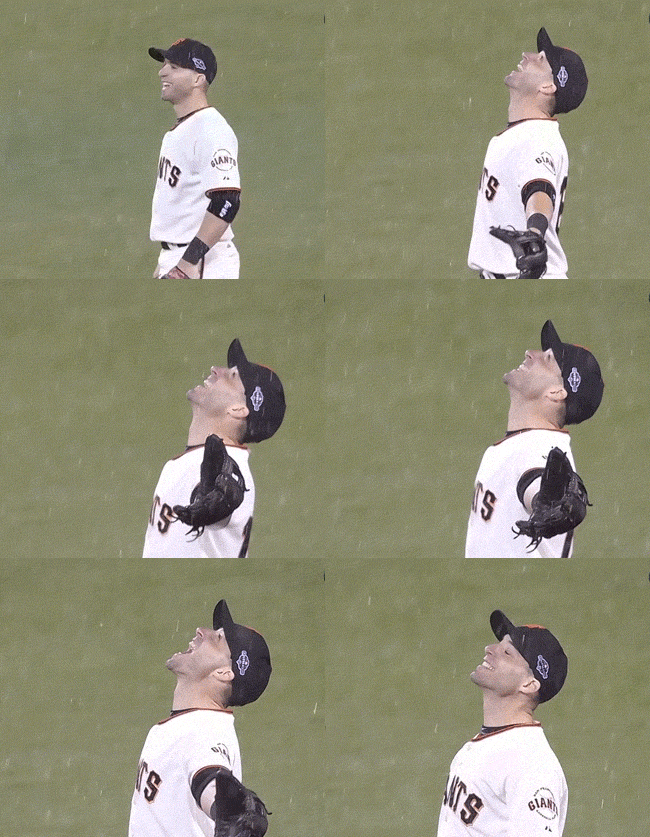
Marco contributed 3 hits and took a walk in the final game of the NLCS, which was decided early on when the Giants took a 7-0 lead by the end of the 3rd inning. But of course, the players had to complete the requisite 9 innings of play, despite the skies opening up to a pouring rain by the top of the 9th. Very appropriately, the NLCS ended when Matt Holliday, the man sacked Marco game 1, popped a ball straight up to the skies where it mixed with the rain to drop into the glove of the Giants’ magical second baseman. Did he think that the moment was pure magic? Judge for yourself. 
Image courtesy of SBNation
Of course, describing Marco Scutaro’s NLCS as “magical” doesn’t mean his success was mana granted from the heavens. As Blue Jays fans may remember, Marco had a knack of creating magic: remember when he took second base on a walk when he caught the Phillies’ infielders napping? It is his natural talent, hard work, and intellect that gave him that magic. 

 Marco was awarded the NLCS MVP trophy, and later with a $20-million contract to allow Giants fans to chant “MAR-CO SCU-TA-RO! *clap clap clap clap clap*” every home game he plays in for the next 3 years. Looks like they’ll have more magic in store.

Monday, 17 December 2012

Guest Post: Elimination Game

A look back at magical moments from:
Special guest author Ruhee from Doubleswitching.

"And Carlos Beltran takes a strike from Zito to start the seventh."

In my sports-fan life, one thing I've learned above all others is not to be too optimistic--or, sometimes, not to be optimistic at all. It's hard to do -- I'm guilty of getting my hopes up in every situation, realistic or otherwise, but sometimes you have to prepare yourself for the absolute worst. There are times when nothing appears to be possible and you want to be ready, if only to cushion yourself from potential heartbreak.

Game 5 of the NLCS between the Giants and the Cardinals was just such a moment. The Giants were once again on the brink of elimination, a now-familiar refrain. Down three games to one, they were trotting out a starter who had posted 2.2 innings in his last outing (Game 4 of the NLDS, allowing 2 runs on 4 hits and 4 walks). Barry Zito's first inning in that game had gone out, out, single, walk, walk, walk (run).

I trust you'll forgive me for being pessimistic.

The reaction to Bochy naming Zito as his Game 5 starter went exactly as you'd expect. Woe is us, all is lost, good luck to the Cards in the Series. Bets were placed on Zito's total innings--I took 3, which after the Division Series debacle felt generous. All I could hope for was a gentle loss, a well-fought one which would at least allow the Giants to retain some dignity. The NLCS felt like borrowed time to begin with, and I was steeling myself for the disappointing end.

The bottom of the first was relatively uneventful, a one-out single to Beltran and nothing more. The second, though, started off with a Yadier Molina single followed immediately by David Freese's double to right, and suddenly there we were on the brink of disaster. I assumed, holding my breath, that there was no way Zito would get out of two on/no out without allowing a basket full of runs. 

Strikeout. Intentional walk. Double play.


Well, that was something, wasn't it?
(I was alone, but I'm not above talking to my television when sports are involved.)


Zito made it through the third clean, too: twelve batters, four baserunners, no runs. Luck, surely?

The Giants scored four runs on Lance Lynn the next inning, knocking him right out of the game. Zito had everything he needed, and gave nothing back. Leadoff double in the fourth--stranded. Clean fifth. Clean sixth. 

And there he was, in the seventh inning, and there was Carlos Beltran, taking a strike. None of it made sense and it was wonderful.

Zito was finally pulled at 115 pitches, two down in the eighth and a man on. Six hits, one (INTENTIONAL) walk, six strikeouts, no runs, 64% strikes. The game of his life. One of mine, too. 

It was the defining game of the playoffs for me, right beside Game 5 of the NLDS with the tying run at the plate in four consecutive innings. Seven and two-thirds innings of absolute disbelief every time Zito walked back to the mound. It's always easier to be prepared for anything, but the real magic happens when you're not. 

Congratulations to the San Francisco Giants: 2012 World Series Champions. It was all downhill from there. 


Editor's note: there were a lot of people hoping for this kind of miracle, and evidence of that hope still litters the internet with their hashtag from that night:  #rallyzito


2012 Looking Back from Different Angles


As we approach the end of 2012, baseball fans, without any actual baseball to evaluate, are either looking forward to 2013, or looking back on the events of 2012.
The Mayans approved of this logo.
Funny thing is, I don't enjoy making predictions very much. I have no problem reading them, but they really aren't my cup of tea. Something about looking back and realising how frequently you were wrong, it leaves a bad taste in my mouth.

Who needs a bad taste in the mouth? Not I! And, as a result, not you either.
 
Looking back, then, seemed to be the more enjoyable thing to do. Surely I couldn't have covered every magic moment in 2012 in just a few posts? Of course not. I decided to enlist the help of a few of my Internet friends with this retrospective, and a few of them agreed to give me a Magical Moment that stood out for them in 2012.

Wednesday, 12 December 2012

Guest Post: The Pantomime Home Run

 A look back at Magical moments in.....
    
Special guest author Matt from House of the Bluebird

     With each and every season of baseball comes new moments for us to cherish and remember. There's the no-hitters, the cycles, the ridiculously difficult defensive plays, and of course the walk off home runs. Those moments in baseball are exciting, they're wondrous and some might even say they are magical. However baseball is more than historically significant events, there's a whole other side to the game. 
     That other side being baseball's extensive quirkiness and general wealth of oddities. This other side produces such moments as Giancarlo Stanton's breaking of a panel on the scoreboard at Marlins Park or the Praying Mantis delay that occurred at Nationals Park earlier this year. The moments aren't always memorable nor are they necessarily historical, but they added to my enjoyment of baseball in 2012. Of all the interesting oddities that occurred during the 2012 MLB season, the one moment that particularly piqued my interest was the "The Pantomime Home Run". 
      Pantomime is defined by the Merriam Webster dictionary as "[the] conveyance of a story by bodily or facial movements especially in drama or dance". You might be wondering how exactly this ties into a game of baseball, and you probably aren't alone in that regard. The specific moment that I'm referring to is one that occurred during a game between the Cardinals and Nationals at Busch Stadium on September 29th. In this instance Michael Morse hit a ball off of Kyle Lohse that went just over the wall at Busch Stadium. The ball bounced off the Energizer sign, then bounced back on the wall before coming onto the field of play and into Carlos Beltran's possession. Beltran then threw the ball to the infield where Michael Morse was thrown out.
     The initial call by the umpires was a single, which would have resulted in an out and just one run for the Nationals. However one of the umpires disagreed with the call that was made and being that the ball was hit to a spot where it could be considered a borderline home run it was able to be reviewed through use of instant replay. Up until that point everything that had occurred was relatively procedural, but that would soon change
     After the umpires reviewed the play and made a decision, they explained the situation to Davey Johnson and then to all the players on the base paths, including Michael Morse. They then went on to instruct Morse to not only rerun the base paths, but go back into the batter's box and redo/mime his home run swing as seen in the .GIF below.
     Morse didn't complain, he didn't question the umpire, he just went to the batter's box and swung as he would at any other pitch...it was wonderful. The "Phantom Grand Slam" swing was full of finesse and and Morse's strides were impeccable as he ran around the base paths while being both booed and cheered on by the Cardinals fans at Busch Stadium. An event, as simple as this, at times seems trivial, but it's another contributor to the variety of beloved oddities that are present and prevalent among the online baseball community today (See Graphs, Not). It isn't flashy, it isn't mind-blowing, but it's funny, it's quirky and it's part of what sets baseball apart from the rest of the world of sports.

Sometimes it's the simple things in life that make us smile.


 The video of the play in it's entirety is embedded below, if that does not work here's a link   that can be used instead.

Saturday, 24 November 2012

Pence the Unusual

Since he came to the San Francisco Giants, in a a trade on July 31st of 2012, I gradually became aware of Hunter Pence, baseball player. The unusual way Pence moves, swings, and also, looks, came across clearly from all the Giants fans I follow on twitter. There is this facial expression:
Which, while not all that creepy, per se, becomes more so when you realise that this is just his regular, calm face. There is a kind of, shall we say, intensity there that never goes away. It gives way, instead, to his actual intense expression:
Which, is more attention grabbing than I can manage in the mirror, even on my best mornings. So, there is a certain aura about Pence which follows him around the baseball diamond. That kind of thing is destined to stir up a little bit of magic with it.


Monday, 15 October 2012

Now pinch hitting for number 13....

After the end of the regular season, in all major sports, come the playoffs. In the playoffs, we are often given the impression that there is more pressure to perform. Certainly, the eyes of baseball fan everywhere focus more closely on the teams that graduated from the regular season into the exclusive playoff level. Every few days, another team is weeded out, forced to make plans for next year, and there are more baseball watching eyeballs focused on fewer and fewer teams.

Players must know this. They must see the crowds arriving earlier to their seats, filling in every last row in the stadium. More reporters hang around the clubhouse, more cameras and microphones shadow them in their daily routine. Friends and family who may have been indifferent to their occupation, suddenly want tickets. All those kids from AAA teams who were suited up in big league colours for the last month, eager and bright eyed? Those kids are gone, watching at home. Only the real big leaguers remain. They playoffs aren't any more complicated when the umpire shouts 'Play ball!' every night, but the feeling has to be different. There is something at stake every night. There is an awareness of all these little changes, turning up the pressure one more notch.

People remember what you do in October. That's the way of the baseball world. Dave Winfield waited 11 years to shake the label 'Mr. May'. Bill Buckner only exists in the casual fan's mind for one fateful October moment. Joe Carter hit 396 home runs in the regular season. You can only find one picture of him running the bases in your memory bank. Fisk waving one fair in game six, 1975. Bucky effing Dent. October remembers.

Maybe I know why he's having trouble.
This story has a great, and a goat. Both of them know what October can do to you. Alex Rodriguez has seen baseball in October 11 different years. He knows how it feels to be the great, in 2009 he hit 6 home runs in the post-season. He batted .365/.500/.808 for the month of October, and he got his World Series ring. He is 37 years old, and very well paid. This year, in October, he has not been great. He has been beyond bad. Joe Girardi has batted him third four times. His best efforts have resulted in a line of .125/.222/.125 so far. There is to be no twist in his fate. A-Rod is our goat.

Which means Raul Ibanez is our somewhat unlikely great. He's been to the post-season 5 times himself. In fact, he was in the opposite dugout in 2009 when A-Rod had his big coming out party in New York. He has no ring with the World Series logo on it. Yet.


Friday, 28 September 2012

2 out, Lineout to the pitcher


With one hundred and sixty two games played by 30 teams, there's a lot of baseball to watch. After a certain date, let's say September first, there are certain teams who play just as much baseball as they did in the other months, but there isn't much of a reason to watch it. When the words 'mathematically eliminated' come up all the time after the name of your favourite team, it isn't easy to know why you are watching. The twilight of the season makes us look for justifications to keep watching the also-rans.

The first reason I often hear to compel me to watch a late season game of a poor team is that they can play 'spoiler'. 'Spoiler' resembles baseball, but with the emphasis on helping out a team that isn't even in the building by beating up on their competition for them. Which is all well and good, but I don't often enjoy it. Why? Well, often the only reason my team gets to wear the coveted 'spoiler' hat and jacket, is because their lack of success has led to them having to take off their 'contender' hat and jacket and put them in the closet for next year. 'Contender' is just so much more fashionable than 'Spoiler' brand. The other thing that strikes me is that the teams that don't play well are not likely to spoil anything with any regularity. Often they get schooled by the better teams as to why they weren't on the list of better teams earlier in the year. Bad teams do not improve because the leaves change colour.

Monday, 24 September 2012

Totally Astrotious

It has been a rough four years for the Houston baseball fan. Four losing years, and then the announcement that the team would be changing leagues, which will remove all of the team's traditional rivals from its schedule. That can't help to sell tickets, can it?

I was hanging around at NotGraphs the other day and the Astros were the subject of a recent post.  If you are a baseball fan, and haven't hung out at NotGraphs, you are definitely missing out. If you are in the mood for a little baseball related bric-a-brac, it is a one stop shop. It's also a free shop, where you can take home the memory of a .gif or unedited tweet, or even enjoy a little Dick Allen in great works of literature, for no initiation or membership fees.

The Astro's post in question was this one. And someone in the comments thought it might be helpful, perhaps even enlightening, to find all the other instances of the Astro's that were .gif-able, and to put them in one spot. I don't thing this was suggested with the Houston Astros fanbase in mind, because I would have to believe that putting all of the Astro's moments together like this, is a form of torture any real fan. Especially one who is watching and hoping that they suddenly turn it around. If you are one of those fans, this is your chance to avoid the train wreck. The rest of you can join me after the jump.

Friday, 31 August 2012

A Living Institution

Vin Scully is not a legendary base ball broadcaster, he is the legend of baseball broadcasting itself. If you want to know what it sounded like to hear the Don Larsen perfect game call in the 1956 World Series, one of the voices that broadcasted that game was Vin Scully's. If you want to hear one of the smoothest, most information packed modern broadcasts, listen to a Dodger home game, called by Vin Scully and only Vin Scully.

Now, I could probably point out that Vin has been baseball's great constant voice, and that he has been a Dodger employee longer than they have been the Los Angeles Dodgers. That, all by itself, is magical. Like Vin Scully, and his legacy, there's still more magic to come. Vin Scully remains happily unretired.

Vin is hardly phoning it in, either. In this season alone, he came up with a more descriptive term for the outfield shift, he learned about twitter, still thinks fast enough on his feet to lip read and edit a manager's profanity on the fly. He took a picture with Giancarlo Stanton. The young Mr. Stanton noted that meeting Vin was on his 'bucket list'. Are you an item on someone's bucket list? I didn't think so.

The baseball gods, (who control all that is uncertain in the game I love), can be fickle, but one would assume that they are pleased with having Mr. Scully as their standard bearer. Since he is not a player, the baseball gods cannot offer up a spectacular catch, or a walkoff win to Mr. Scully. They have given him the chance to call some of the greatest moments in the game. Perhaps not knowing what to get Vin this year, the baseball gods got him a bobblehead.


Now, that's really nice, but these aren't the baseball grandmas or baseball cousins working the magic here. Anybody can get a bobblehead made, but only the baseball gods can work the magic as you are coming down on the field to get the bobblehead.

From twitter:


And from the Dodgers Instagram account.

Yes, everything went exactly as well as you would expect for Vin Scully in Dodger Stadium. Plus a rainbow.


Saturday, 18 August 2012

Top of the 7th: Flyout, LF (Deep Left)


A great catch is like watching girls go by; the last one you see is always the prettiest. - Bob Gibson


I'm going to go back in time a little bit here, but only about a week, to August 12th, 2012. (This blog is a labour of love, and other labours have not allowed me the time to come to this earlier.) It was in the 7th inning, and the Toronto Blue Jays held a comfortable 6 run lead over the visiting New York Yankees. Casey McGehee was the second batter in the inning, Curtis Granderson having reached base on an infield single.

McGehee launched a 2-0 pitch from Brad Lincoln over the head of Rajai Davis in left field.

To really understand what happened next, we have to add a little bit of context to Rajai Davis and his playing style. Two days earlier, Davis lost a ball in the lights at his home park, which is not unheard of, but certainly unusual. He often takes a wrong first step on fly balls, but uses his blazing running speed to overcome most of his mistakes. His throwing arm is unremarkable, which is why he is in left field, as Colby Rasmus represents a superior option in centre. Davis often appears just a bit indecisive in the outfield. He's certainly a step up from Eric Thames, and worlds apart from Adam Lind, but how he will play the bounce on a ball over his head is always a lingering question.

Tuesday, 7 August 2012

A Long Season

It is a long season.

You have probably heard that more times than you can count, if you are a baseball fan. It is, mathematically, the longest season of any professional sport. 162 games in 6 months, each lasting 3-4 hours, give or take an hour here and there. That's the most time spent on the field of any sport. So, we hear, quite often, about the long season.

The length of the season, just by adding up days, doesn't really approach the problem of the Long Season, though. Those 162 games are played six or seven days in a row, on a regular basis. The limit on the number of consecutive games played? Let me give you the official wording:
(12) No Club shall be scheduled, or rescheduled if practicable, to
play more than 20 consecutive dates without an open day. A rainedout
game may be rescheduled to an open date in the same series, or
to an open date at the end of the same series, if (a) the open date is
a road off-day for the visiting Club, and (b) the rescheduling does
not result in the home team playing more than 24 consecutive dates
without an open day.
Yes, twenty day in a row are possible in the regular conduct of business in the MLB. Have you ever worked twenty days in a row at your job? Even if your job isn't the most demanding in the world, how would you think of your job at the end of a twenty day stretch. I would call it a grind. I might include a few curse words before the word 'grind', but 'grind' would be my general feeling.

Baseball is a long grind.